VMPL
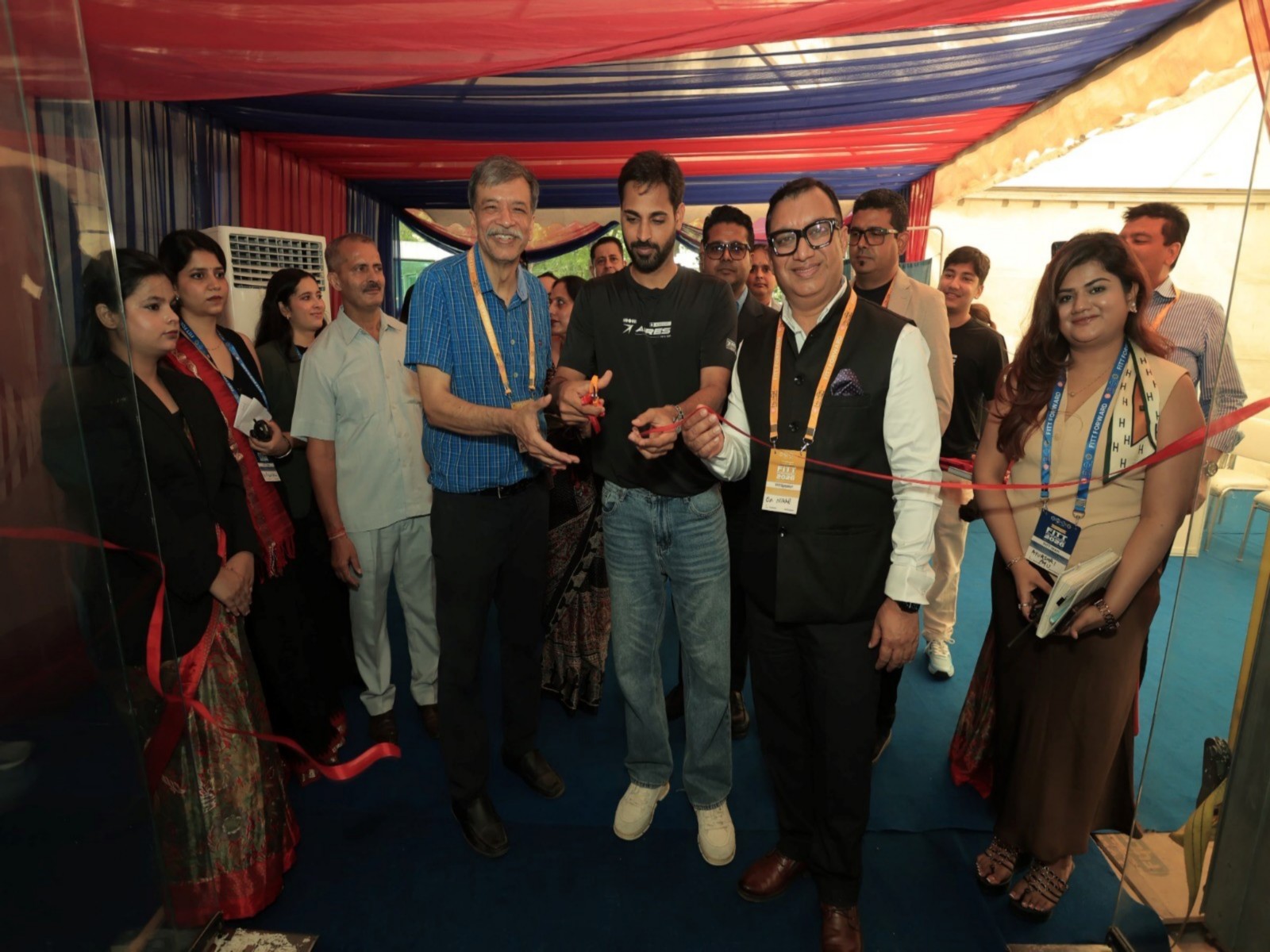
New Delhi [India], September 12: Can India build artificial intelligence for 1.4 billion people, and for the world? Can it become a space superpower, a semiconductor manufacturer, and a healthcare innovator, all within the same decade? These were the questions the Foundation for Innovation and Technology Transfer (FITT) at IIT Delhi put directly to the people building the answers, as the second edition of FITT Forward, a two-day summit, concluded on 11th September at the FITT-IIT Delhi campus in New Delhi. The opening morning on 10th September had featured a fireside conversation between Bhuvaneshwar Kumar, cricket icon and investor, and Sachin Marya, Editorial Director at Entrepreneur India & APAC, on his journey from performance to entrepreneurship.
"In sports there's a lot of chance for technology. It has really taught me a lot in life, especially when I was injured and I couldn't show up to the stadium. I am here today, as an investor and not as a sportsman. I believe there is a lot of scope that technology has in sports and that's the reason I chose to start my journey as an investor. Thank you so much for inviting me." – Bhuvaneshwar Kumar, Cricket Icon and Investor
"FITT focuses on arms creation, licensing technology and startups. IIT Delhi focuses on creating infrastructure for young entrepreneurs who are inspired to enter the tech world. It provides them with the right ecosystem, resources and support to transform their ideas into practical innovations and eventually build successful ventures." – Prof. Vivek V. Buwa, DDSP, IIT Delhi
"FITT Forward 2026 is designed to move the conversation from India's ability to innovate to its ability to own and scale the technologies that will shape the next decade. By bringing founders, investors, industry and policymakers into one room, we want to turn ambition in areas such as AI, semiconductors, space and biotechnology into partnerships, capital and companies that can compete globally." – Dr. Nikhil Agarwal
Following an edition in 2025 that closed with more than twenty memoranda of understanding and over thirty startup-investor meetings, this year's summit widened its lens considerably. Where the first edition spoke largely to mobility, health-tech and green-tech, the 2026 programme put sovereign artificial intelligence, semiconductor manufacturing, agriculture, space technology, biotechnology and sports technology on the same stage, and asked a harder question of each: not whether India can innovate, but whether it can own the technologies that will define the next decade.
That question opened the summit directly on Day One. In the first panel, "Can India Build AI for 1.4 Billion, and the World?", Pradeep Gupta, Chairman and Managing Director, CyberMedia Group, chaired and moderated a conversation with Prof. Mausam of the Department of Computer Science and Engineering, IIT Delhi, Kavita Bhatia, Scientist G and Group Coordinator for AI and Emerging Technologies at MeitY, and Sandeep Aurora, Group Director and Head of Public Policy and Government Affairs at Microsoft India and South Asia, on whether India's AI ambitions could move from government mission to global company. The conversation on who pays for that ambition followed immediately after, as S.P. Singh, Nodal Officer In-Charge of the RDI Fund, Praveen Ganapathy, Chief Tech Investment Officer at Dani Family Office, Kunal Bhanot, Head of Investments at DS Group Family Office, and Deepak Sharma, Co-Founder and Managing Partner of India Accelerator, debated what patient capital for deep-tech actually looked like in India, moderated by Anagh Singh, Vice President, Singularity AMC.
The afternoon turned from software to steel. In "Can India Build the Technologies That Power the World?", Marmik Bhatt of Monk9 Tech, Priya S. Kapur of Sona Comstar, Taranjit Kukal of Cadence Design Systems, Dr. Shailendra Singh, Executive Vice President of Maruti Suzuki, and Manu Iyer of BlueHills Capital examined India's opening in advanced manufacturing and semiconductors, moderated by Kiran Deshpande, former CEO of TechM, following opening remarks by Prof. Sunil Jha, Associate Dean (R&D), IIT Delhi. The agritech panel that followed, "From Farm to Future," brought together Dev P. Goel, Chairman and MD of Madhu Group and ConQuerent, Krishanu Nandan Gupta, India Head of KRAMP India, Lalit Kumar, AVP R&D at Beri Udyog Pvt. Ltd. (Fieldking), Prof. B.R. Kamboj, Vice Chancellor of Chaudhary Charan Singh Haryana Agricultural University, and Prof. Arun Mohan Sherry, Director of IIM Shillong, moderated by Himanshu Rattan, Partner at KPMG India, Government and Public Services, to ask what it would take for Indian agriculture to compete globally rather than simply subsist.
A DeepTech Keynote by Dr. Anita Gupta, former Scientist G and Head of CEST at the Department of Science and Technology, traced India's path from government-funded research to global commercial scale, before the day turned to storytelling itself. In the Unicorn Fireside, "How I Built a Unicorn: From Idea to Scale," founders Ankit Agrawal, Founder and CEO of InsuranceDekho, Kapil Bharti, Co-founder and CTO of Delhivery, and Sandeep Nailwal, Co-founder of Polygon, recounted, in their own words, what it actually took to go from an early idea to scale, moderated by Rohit Jain, Managing Partner, Singhania & Co. Day One closed with the signing of two memoranda of understanding — between FITT and World of Innovation (WOI), and between TechnoSport and AIC-IIT Delhi to build a dedicated SportsTech accelerator — and closing remarks by Prof. Rangan Banerjee, Director, IIT Delhi. Running alongside the main stage for five hours, a closed-door Demo Day gave a curated set of startups, including several led by women, students and rural innovators, the floor to demonstrate live products directly to investors.
Day Two, held on 11th September, carried sessions on India's space ambitions, health and biotechnology, institutional capital for deep-tech, and sportstech, and closed with the FITT Forward Innovation Awards 2026.
"The next wave of Indian innovation will not be defined by one sector or one technology—it will emerge at the intersection of research, entrepreneurship, capital and national priorities. FITT Forward brings these seemingly different domains together because India's innovation ecosystem will be strongest when ideas can move seamlessly from the laboratory and the field to the factory, the market and ultimately the world." – Prof. Rangan Banerjee, Director, IIT Delhi.
As with its first edition, FITT Forward 2026 kept inclusion at its centre throughout the two-day summit, with student-led, women-led and rural innovator teams demonstrating live alongside established deep-tech ventures on the expo floor. As of the 2025 edition, FITT had incubated over 280 startups, facilitated more than ₹450 crore in cumulative funding, and commercialised 25 global patents.
FITT Forward 2026 was supported by Microsoft as Technology Partner, WOI.India as Global Investment Partner, HS Foundation as Innovation Partner, IIFL Capital as Treasury Partner, Singhania & Co. LLP as Legal Partner, and Indigotex as Gifting Partner.
For more information visit: https://fitt-iitd.in/web/home
(ADVERTORIAL DISCLAIMER: The above press release has been provided by VMPL. ANI will not be responsible in any way for the content of the same)