Lendingkart on Public Capex Increase: Turning INR 11.2+ Lakh Crore Spending into Opportunities for MSMEs with the Right Business Loans
BusinessWire India
Mumbai (Maharashtra) [India], March 7: On 1 February, the Union Budget announced government plans to significantly increase its capital spending. The allocation is INR 11.21 lakh crore for FY 2025-26 and is expected to increase further next year. For MSMEs, this will shape how demand and business opportunities develop in the period ahead.
When the government spends at this scale, it creates work across the economy. Large projects rely on many suppliers, contractors, and service providers, and MSMEs are a key part of this chain. Along with new projects, the budget also focuses on structural reforms such as easier access to MSME business loan options, simpler tender participation, and better support for business expansion.
However, accessing these opportunities requires more than just intent; it requires immediate liquidity. When a tender opens, the window to mobilise resources is often short. This is where the synergy between government policy and agile financial partners becomes critical. Platforms like Lendingkart are increasingly pivoting to ensure that, as the government opens doors, MSMEs have the immediate working capital required to walk through them, moving beyond the slow processing times of traditional financing.
Lendingkart explains how government spending turns into real opportunities for MSMEs, what role policy reforms play, how a business loan for MSMEs can support growth during this phase, and how you can position your enterprise to benefit from this momentum.
Public Capex Meaning
Public capital expenditure refers to the funds the government allocates for creating long-term physical assets such as transport infrastructure, power facilities, public buildings, and urban infrastructure. Unlike revenue expenditure, which covers recurring expenses such as salaries and administration, capital expenditure (capex) focuses on asset creation that adds to the country's productive capacity.
This is important because most public projects are executed through private participation. The government relies on local manufacturing units, contractors, and service providers for materials, equipment, construction, and ongoing services. As public capex increases, project activity rises, procurement expands, and MSMEs across the supply chain see more structured and sustained business opportunities.
Capital Expenditure Allocation Across Key Sectors
Now that the concept of capital expenditure is clear, the next step is to see where the money is going. The Union Budget outlines specific sectors where capital spending will be concentrated, offering a clear view of priority areas.
Reference Link: https://www.indiabudget.gov.in/index.php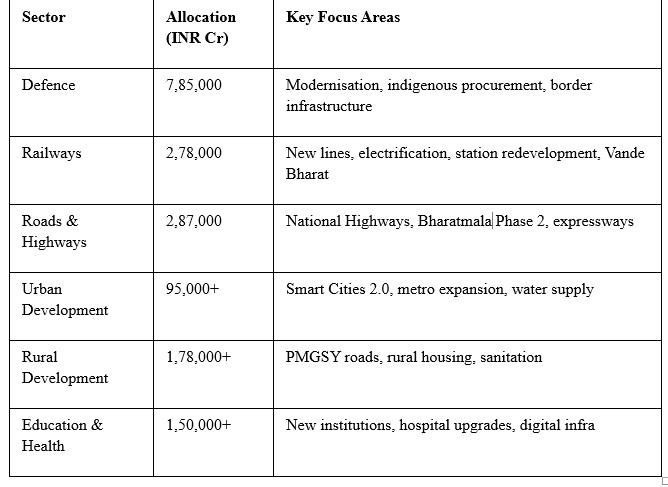
These allocations will open up a wide range of opportunities for MSMEs across sectors. As capital spending increases in areas such as railways, defence, roads, and urban development, demand rises for components, materials, services, and specialised support across the value chain. This sector-wise flow of spending creates multiple entry points for MSMEs, particularly in areas linked to local manufacturing and domestic supply chains.
Direct Procurement and Tender Opportunities
Once key sectors are identified, the next step is understanding how businesses can access this spending. Government procurement is becoming more inclusive, with a stronger focus on participation from MSMEs and local manufacturing units.
Massive Infrastructure Pipeline
Higher capital spending leads to more infrastructure projects across roads, railways, ports, and urban development. While large firms may secure the main contracts, these projects rely on a wide network of suppliers for materials, components, services, and maintenance. This structure allows MSMEs, especially those involved in local manufacturing, to participate across different stages of execution.
MSME Procurement Mandate
To ensure smaller businesses benefit consistently, the government has formalised procurement rules as part of broader government schemes for MSME growth. Central ministries and public sector enterprises must source at least 25% of their annual purchases from MSEs, with dedicated sub-targets for SC/ST-owned and women-owned enterprises. These measures provide a structured and reliable pathway for MSMEs that meet quality and compliance requirements.
The INR 10,000 Crore SME Growth Fund
As outlined in the Union Budget, the ability of MSMEs to scale alongside higher public spending has become a key focus. To support this, an INR 10,000 crore SME Growth Fund has been proposed to help small businesses grow at the right time.
This fund is different from a regular MSME business loan. Instead of short-term financing, it is designed to provide growth capital so businesses can expand capacity, upgrade technology, and meet the requirements of larger contracts. The aim is to help MSMEs move from small-scale execution to handling bigger opportunities with confidence.
Enhanced Credit Guarantees (CGTMSE) And Speed
While some businesses may look for growth capital, many simply need easier access to debt without heavy collateral requirements. This is where the Credit Guarantee Fund Trust for Micro and Small Enterprises, or CGTMSE, becomes relevant.
As part of the Union Budget approach to strengthening MSME financing, additional support has been provided to expand CGTMSE coverage. This gives banks and NBFCs greater confidence to lend, as a portion of the risk is backed by the government. For MSMEs, this can mean simpler access to an MSME business loan, with reduced collateral pressure and better support for meeting working capital needs linked to new orders.
In a capex-driven economy, speed is currency. This is where digital lending platforms have transformed the landscape. By simplified documentation, Lendingkart enables MSMEs to bypass the waiting period associated with business loans. Whether it's bridging a gap for material procurement or scaling the workforce for a new tender, the ability to secure unsecured business loans online ensures that capital availability matches the pace of project execution.
Improving Cash Flow Access through TReDS Upgrades
Delayed payments are one of the biggest challenges for MSMEs working on large projects. You deliver the work, but payments often take months to come through. To address this, the government is strengthening the Trade Receivables Discounting System, or TReDS, to improve cash flow for MSMEs.
- CPSE Mandate: Central Public Sector Enterprises will now be required to use TReDS to settle payments with MSMEs. This ensures faster payment cycles and also encourages private buyers to adopt the same system.
- Credit Guarantee Integration: A dedicated credit guarantee support through CGTMSE has been introduced for invoice discounting on TReDS. This reduces risk for lenders and makes it easier for MSMEs to raise funds against approved invoices.
- GeM Integration: The Government e-Marketplace will be linked with TReDS to share transaction data with financiers. This helps MSMEs access quicker and more affordable advances against government orders.
- Secondary Market Creation: Invoices on TReDS will be converted into asset-backed securities, creating a secondary market. This improves liquidity in the system and speeds up the availability of funds.
Together, these steps make it easier for MSMEs to convert invoices into cash without long delays. When combined with other government schemes for MSME financing, they help reduce the working capital pressure that often affects businesses supplying to government projects.
Introducing 'Corporate Mitras' for Easier Compliance
To support MSMEs in making the most of new opportunities, the government has introduced the concept of "Corporate Mitras." The aim is to simplify compliance and reduce the effort required to meet regulatory requirements.
Corporate Mitras act as a support link between MSMEs and government systems, helping with routine filings and documentation. This cuts down time spent on paperwork and allows businesses to focus more on local manufacturing and daily operations, which is a key priority highlighted in the MSME Budget.
Reviving Legacy Clusters
The capex push is not limited to new infrastructure projects. It also focuses on strengthening traditional industrial clusters that already support a large number of MSMEs. The budget has allocated funds to modernise long-standing hubs, such as the textile clusters of Gujarat and the brassware cluster of Moradabad.
This support includes common facility centres, better waste treatment systems, and improved logistics connectivity. For MSMEs operating in these clusters, this means access to upgraded infrastructure without having to invest individually. These efforts help revive local manufacturing hubs and improve efficiency at the ground level.
What Does this Mean for Your Business
Higher capital spending is expected to lead to more tenders across sectors and at both the central and state levels. New areas such as green energy, digital infrastructure, and advanced manufacturing are also opening up, giving MSMEs more options to expand into related lines of work.
At the same time, improvements in payment systems and credit support have made participation easier. Faster invoice discounting, stronger guarantees, and better digital platforms help reduce cash flow gaps that earlier made government projects difficult for smaller businesses.
As these opportunities grow, access to timely funding becomes essential. Securing the right MSME business loan or working capital support through platforms like Lendingkart can help MSMEs bid confidently, execute orders smoothly, and scale without financial strain.
The Union Budget signals a clear push toward higher capital spending, backed by policy reforms and financial support aimed at improving MSME participation. Together, these measures create a more structured environment where opportunities are easier to identify and access.
Ultimately, the difference between winning a tender and passing it up often comes down to financial confidence. With Lendingkart's focus on offering collateral-free business loans and rapid disbursals, MSMEs are no longer restricted by asset-heavy requirements or slow banking approvals. By aligning your financial planning with a partner that understands the urgency of government contracts, you ensure that your business is ready to capitalise on the INR 11.2+ lakh crore wave.
For MSMEs, especially those engaged in local manufacturing, this means better visibility, smoother execution, and stronger support systems. With the right planning and access to finance, businesses are better positioned to align with this spending cycle and grow sustainably.
(ADVERTORIAL DISCLAIMER: The above press release has been provided by BusinessWire India. ANI will not be responsible in any way for the content of the same)