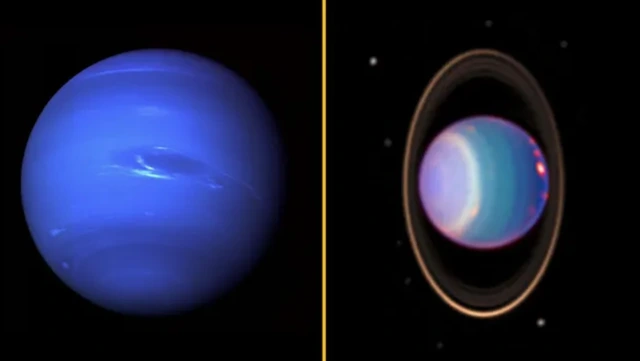
Washington [US], December 27: New computer models suggest that the cores of Uranus and Neptune likely contain less ice and more rock than their long-held nickname, 'ice giants,' might suggest.
The cores of Uranus and Neptune may contain more rock than scientists previously thought, according to Live Science on December 26, citing a new computer model that challenges the idea that the two planets should be called "ice giants".
A report published in the journal Astronomy & Astrophysics may help explain the anomalous magnetic fields of these planets.
Uranus and Neptune are relatively large planets at the edge of our solar system. Neptune is the farthest planet from the sun, with an average distance of about 4.5 billion kilometers.
At such great distances, the extremely low temperatures cause gases like hydrogen, helium, and water to condense into compressed ice, which is believed to form the planet's core. Therefore, Uranus and Neptune have long been known as the ice giants.
The report's lead author, Luca Morf, a doctoral candidate at the University of Zurich (Switzerland), argues that such a massive classification of ice is overly simplistic, given that humans still know very little about Uranus and Neptune.
Graduate student Morf and his supervisor, Ravit Helled, have developed a new model to more accurately describe the cores of frigid planets at the edge of our solar system.
The model was built to be both objective and consistent with the principles of physics.
Thanks to the model, the research team found eight possible core structure scenarios for the planetary pair, three of which showed a relatively high ratio of rocks to water in the planets' cores.
This suggests that the cores of the two planets are not limited to ice as previously assumed.
Source: Thanh Nien Newspaper